
Has it been months since you gave birth and your abdomen still bulges, as if you were still pregnant? It may not be fat. It could be abdominal diastasis.
It is one of the most common consultations after a pregnancy. And it almost always comes with the same question: will it sort itself out, will physiotherapy fix it, or do I need surgery?
In this guide I explain it clearly. You will see how to suspect it, when conservative treatments are enough and when the solution is an abdominoplasty with diastasis correction.
What is abdominal diastasis?
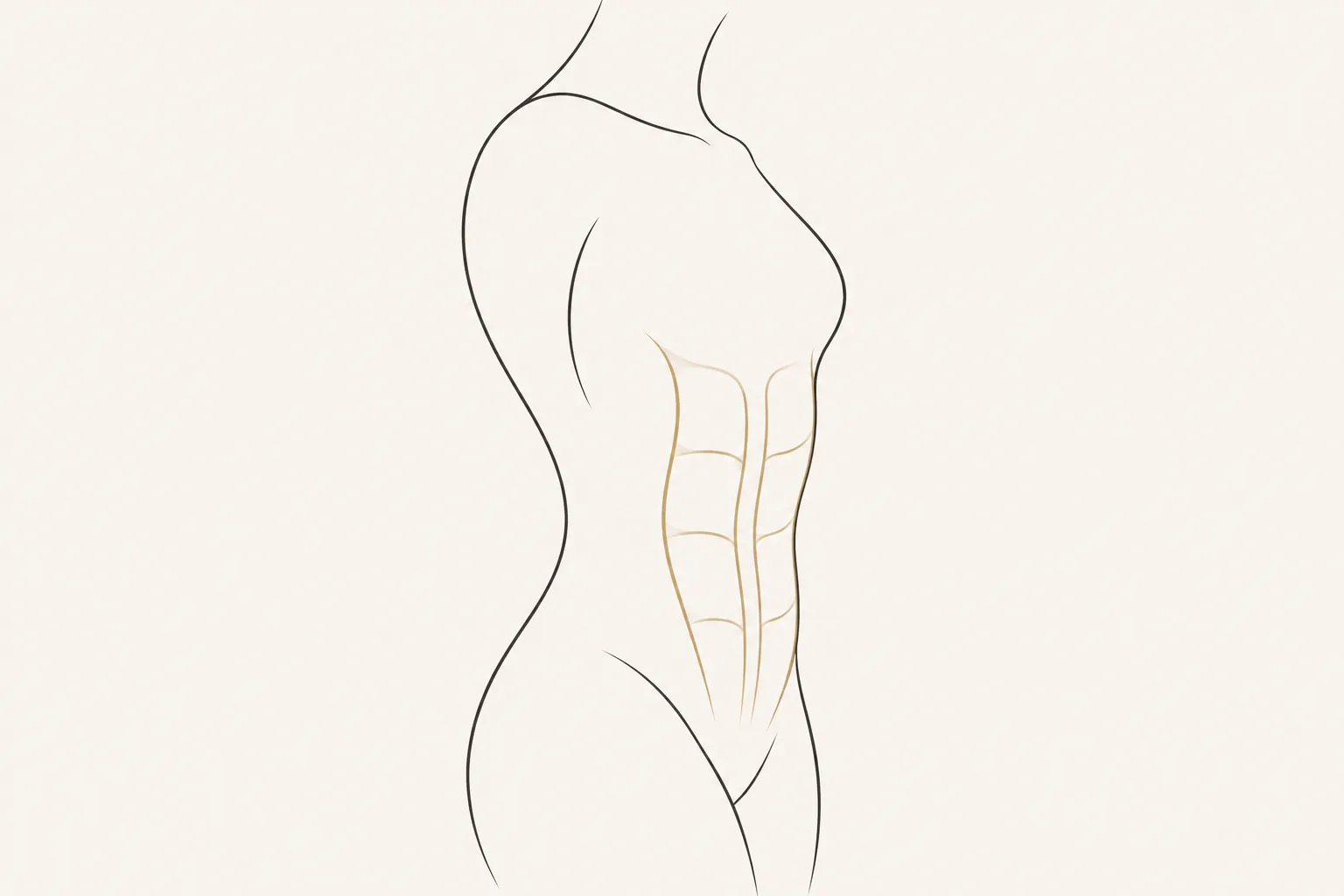
Abdominal diastasis, or diastasis recti, is the separation of the two rectus muscles of the abdomen. They are the ones that form the “six-pack”.
Between them there is a band of tissue called the linea alba. If that band stretches and slackens, the muscles move apart and the abdominal wall loses firmness.
The result is a bulge in the centre of the abdomen. It is more noticeable when you sit up or strain. It is not a hernia, although the two can coexist.
It is not just cosmetic: a weakened abdominal wall can give you a feeling of instability.
Why it appears: diastasis and pregnancy
The most common cause is pregnancy. The uterus grows, the abdominal wall stretches and the linea alba gives way.
During pregnancy, this separation is to be expected. After the birth, in many women it improves partially. In others it never fully recovers.
These factors make it more likely:
- Pregnancies close together or multiple pregnancies
- Carrying twins or a large baby
- Significant weight changes
- A weak abdominal wall due to personal or family predisposition
It also appears in men and in people who have never been pregnant.
How do you know if you have abdominal diastasis?
These signs can put you on alert:
- A lump or elongated groove in the centre of the abdomen when you sit up
- A belly that looks pregnant months after the birth, even though you are back to your usual weight
- A feeling of a soft, weak abdomen
- A gap you can feel with your fingers along the central line
Many people search for abdominal diastasis photos to compare themselves. They help you get an idea, but they do not replace an examination. You can see a real case: Carla's case, abdominoplasty after pregnancy.
Lie on your back with your knees bent and lift your head slightly. With your fingers, feel along the central line, above and below the navel. If you feel a gap or see the centre bulge, get it checked. It is only a guide: the diagnosis and measurement are made by the specialist after examining you.
Types of diastasis recti
They are not all the same. They can be classified in several ways, and this affects the treatment.
- By area: above the navel, around it or below it. Many affect several areas at once.
- By severity: mild, moderate or marked, depending on how far the muscles separate and how lax the linea alba is.
- By what accompanies it: excess skin, abdominal fat or an umbilical or epigastric hernia.
At the consultation the separation is measured. But the figure alone does not decide the treatment. Your symptoms, the firmness of the wall and how it responds to rehabilitation carry more weight. The specialist assesses this.
Does abdominal diastasis hurt?
Not always. Some people have no discomfort at all and others notice it every day.
The most common symptoms are:
- Pain or tiredness in the lower back
- A feeling of weakness in the centre of the body
- Bloating or abdominal heaviness
- Discomfort around the navel, if there is an associated hernia
These symptoms have many possible causes. Do not put them down to diastasis without a professional examining you.
If you notice a painful lump that does not go back in, or severe pain with vomiting, go to A&E. It could be a complicated hernia.
Can it be corrected without surgery?
Sometimes it can be improved, and it is a very reasonable first step.
A physiotherapist specialised in the pelvic floor and abdominal wall can help you regain function and a sense of strength. It is serious work and deserves respect. In this article you will not find exercise routines: they are personal and are guided by whoever examines you.
It is worth allowing time after the birth before thinking about other options.
That said: conservative treatment improves how the abdomen works. It does not always fully close the separation or remove the excess skin.
When is surgery needed?
Surgery is considered when the abdomen does not improve with conservative treatment. These situations usually lead to considering it:
- The separation does not improve after a reasonable period of rehabilitation
- There is excess skin that physiotherapy cannot correct
- There is an associated umbilical or epigastric hernia
- The discomfort or lack of firmness limits you in your daily life
The surgical solution is abdominoplasty with diastasis correction. It is the operation that repairs the abdominal wall and removes the excess skin.
Before deciding, bear two things in mind. A new pregnancy can stretch the abdominal wall again. That is why it is usually best to wait until your weight is stable and you have completed your family.
And an honest clarification: surgery is not for losing weight. If the bulge comes mainly from the fat inside the abdomen, plication does not resolve it. This is clarified at the examination.
What is rectus plication and how is it done?
Rectus plication is the technique that corrects diastasis. The surgeon folds and sutures the tissue covering the muscles. This brings them back towards the midline and reinforces the wall.
It is performed as part of an abdominoplasty. This way the excess skin is removed at the same time and, if needed, the navel is repositioned.
If there is also localised fat, it can be combined with liposculpture of the abdomen and flanks.
Dr. Martín Gastón Álvarez decides on the technique after examining you: full or mini abdominoplasty, depending on where the separation is and how much skin is left over. The operation is performed in a hospital.
Recovery, scarring and risks
It is major surgery and recovery takes patience. As a guide:
- Everyday activities without strain: between 7 and 14 days, depending on the case.
- Abdominal compression garment: between 4 and 6 weeks, as the surgeon indicates.
- Most definitive result: between 6 and 12 months, when the skin adapts and the scar matures.
The scar lies in the lower part of the abdomen. The surgeon will tell you at your check-ups when to resume physical activity.
Like any major surgery, it carries risks: fluid collection, haematoma, infection, healing problems or thrombosis. Dr. Martín Gastón Álvarez explains them to you at the consultation, tailored to your case.
At Natural Fit the method does not end in the operating theatre. It combines surgery, a nutritionist and check-ups with the surgeon throughout your recovery.
Your first assessment at Natural Fit
If you have doubts, the most useful thing is to have a specialist examine you. At your first assessment with Dr. Martín Gastón Álvarez:
- Your abdomen is examined to see whether there is diastasis, a hernia or excess skin
- Your pregnancies, your history and your future plans are reviewed
- You are told clearly whether it is better to continue with rehabilitation or to consider surgery
Sometimes the answer is that surgery is not needed. And we will tell you so all the same.
Your first assessment can be in person or online. The consultation is at Passeig de la Bonanova 69, 4th floor, Barcelona. Financing plans are available.
If you prefer to start with a message, message Cleo on WhatsApp. She is our virtual assistant and replies straight away.
Frequently asked questions about abdominal diastasis
Does abdominal diastasis go away on its own?
Separation is to be expected during pregnancy. In many women it improves partially in the months after giving birth. If, after some time, there is still a bulge or discomfort, it is worth having a specialist examine you. Every case evolves differently.
How do I know if I have diastasis or just belly fat?
Fat feels soft and can be pinched. Diastasis shows as a bulge or a central groove that appears when you tense your abdomen. They can occur together. Only a professional examination can confirm it.
Is physiotherapy enough to treat diastasis?
In many cases it is the first step and it can improve how the abdomen functions. If the separation does not improve, there is excess skin or there is a hernia, surgery may be needed. The specialist assesses this in each case.
Is an abdominoplasty the same as operating on diastasis?
Not exactly. Abdominoplasty removes excess skin and rectus plication corrects the diastasis. They are usually done in the same operation when both are indicated.
When can I have surgery for diastasis after pregnancy?
There is no fixed date. It is usually best to wait several months after the birth, until breastfeeding has finished. It also helps if your weight is stable and you have completed your family. A new pregnancy can stretch the abdominal wall again. You settle this at the assessment with the surgeon.
How long does recovery from the operation take?
As a guide, between 7 and 14 days to return to everyday activities without strain and between 4 and 6 weeks in a compression garment. The most definitive result is seen between 6 and 12 months. The surgeon sets the timeframes at your check-ups.
Questions about your abdominal diastasis?
Book your first assessment with Dr. Martín Gastón Álvarez, in person or online. We will explain which option suits you, including not having surgery.